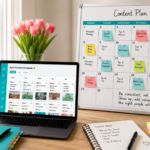
How to Turn One Idea Into a Month of Content
Creating content can feel exhausting when every post begins with the same question:
“What are we going to post today?”
Businesses often assume they need a completely new idea for every platform, every format and every day of the week. This leads to rushed posts, inconsistent messaging and a content plan that becomes impossible to maintain.
A strong content repurposing strategy offers a better approach.
Instead of creating more ideas, you take one valuable idea and develop it into multiple pieces of content for different platforms, formats and stages of the customer journey.
One idea can become a blog, carousel, email, Pinterest Pin, LinkedIn post, Story sequence and short video.
The message remains consistent, but the way you present it changes.
What Is Content Repurposing?
Content repurposing is the process of taking an existing idea or piece of content and adapting it into new formats for different platforms and audiences.
It is not simply copying and pasting the same caption everywhere.
Effective content repurposing considers:
- How people use each platform
- How much information they expect
- Which format is most useful
- What action you want them to take
- Where they are in the customer journey
For example, someone may discover your idea through a short Instagram post, save the infographic on Pinterest, read the complete blog on your website and later respond to an email.
Each piece of content performs a different job, but they all begin with the same central idea.
Why Should Businesses Repurpose Content?
Businesses should repurpose content because it helps them communicate more consistently without constantly starting from scratch.
A good idea deserves more than one post.
Not everyone sees your content the first time you publish it. Your audiences also consume information differently. Some prefer a detailed article, while others respond to a visual checklist, short caption or quick video.
A thoughtful content repurposing strategy helps your business:
- Save planning and production time
- Reinforce important messages
- Reach people across different platforms
- Build stronger website content
- Improve brand consistency
- Create more value from each idea
- Keep useful content visible for longer
Repurposing also gives your content a clearer purpose. Instead of publishing a collection of unrelated posts, your business can build a coordinated campaign around one useful topic.

Start With One Strong Core Idea
Not every passing thought needs to become a month-long campaign.
The best core ideas usually:
- Answer a common customer question
- Solve a real problem
- Explain something people misunderstand
- Connect to one of your services
- Support an upcoming campaign
- Demonstrate your expertise
- Provide a useful process or framework
Your core idea should be broad enough to explore from different angles but specific enough to offer a clear takeaway.
For example:
Core idea: Businesses should use slower seasons to strengthen their marketing.
That single idea can explore website improvements, Google visibility, content planning, customer journeys and campaign preparation.
The core idea becomes the foundation. Every additional piece of content develops one part of it.
Build the Pillar Content First
Pillar content is the most detailed version of your idea.
For many businesses, this could be:
- A blog article
- An educational guide
- A case study
- A podcast episode
- A webinar
- A long-form video
- A downloadable resource
A blog is particularly useful because it gives you room to explain the idea properly while building valuable content on your website.
It can also support search visibility by answering the questions potential customers are already asking.
Once the pillar article is complete, you no longer have to create every social post from a blank page. You can extract the strongest lessons, examples, statements and visuals directly from the article.
Turn the Idea Into a Month of Content
Here is how one pillar idea can become an entire content campaign.
1. Publish the Main Blog Article
The blog contains the complete idea.
It should answer the main question, explain why the topic matters and give the reader practical guidance.
Your blog becomes the destination that your other content can direct people towards.
It also gives your website a growing library of useful information that can be discovered through search engines, shared on social media and referenced in future articles.
2. Create a Social Media Carousel
A carousel can turn the article’s main points into an easy-to-follow visual story.
If your blog includes five steps, five mistakes or five recommendations, each can become a carousel slide.
A simple structure could be:
- Strong opening headline
- Explain the problem
- Share the first lesson
- Share the second lesson
- Share the third lesson
- Summarise the takeaway
- Invite readers to visit the blog
The carousel should offer useful information on its own while giving interested people a reason to read the complete article.
3. Share One Strong Takeaway
Not every social post needs to summarise the entire blog.
Choose one sentence or lesson that can stand alone.
For this article, that could be:
You don’t need more content ideas. You need to use your best ideas better.
A strong takeaway can become:
- A Facebook post
- An Instagram graphic
- A LinkedIn discussion
- A Story
- A quote card
- A short text-based video
This allows you to reinforce the main message without repeating the complete article.
4. Design a Saveable Infographic
If your pillar content contains a process, checklist or framework, turn it into an infographic.
Infographics work particularly well for:
- Step-by-step processes
- Customer journeys
- Checklists
- Comparisons
- Statistics
- Timelines
- Frameworks
A useful infographic can be included inside the blog and shared separately on Pinterest or social media.
It provides immediate value while directing people back to the longer article for more detail.
5. Create a Story Sequence
Stories can break the idea into short, conversational moments.
For example:
Story 1:
Struggling to think of something new to post?
Story 2:
You probably don’t need another idea.
Story 3:
One strong idea can become a blog, carousel, email, Pin and video.
Story 4:
The secret is a clear content repurposing strategy.
Story 5:
Read this week’s Wednesday Wisdom.
Stories can also include a link sticker that takes viewers directly to the blog.
6. Adapt the Idea for LinkedIn
LinkedIn audiences often respond well to useful professional observations, practical lessons and thoughtful discussions.
Instead of simply sharing the blog link, use the central idea to begin a conversation.
For example:
Many businesses do not have an idea problem. They have a content system problem.
They create one post, publish it once and move on.
A valuable idea could become a blog, social campaign, infographic, email and video. The goal is not to say the same thing repeatedly. It is to give the idea more than one opportunity to reach the right person.
You can then invite readers to explore the complete framework on your website.
7. Create Pinterest Pins
Pinterest can help useful, evergreen content remain discoverable long after the original publication date.
From one blog, you could create:
- A Pin featuring the article title
- A tall infographic
- A checklist Pin
- A quote Pin
- A step-by-step process Pin
Each Pin can link directly to the original blog.
Unlike a fast-moving social feed, useful Pinterest content can continue sending people to your website when they search for related ideas later.
8. Use the Topic in an Email
Your email does not need to include the entire article.
Introduce the problem, share one valuable takeaway and invite readers to continue on the blog.
For example:
If creating content constantly feels exhausting, the problem might not be a shortage of ideas.
One strong idea can support weeks of content when it is adapted thoughtfully for different formats and platforms.
The email gives the original idea another opportunity to reach people who may not have seen it on social media.
9. Turn the Article Into a Short Video
Video can be added once the written and visual campaign is already in place.
The article could become:
- A 30-second tip
- A talking-head video
- An animated infographic
- An AI presenter video
- A behind-the-scenes explanation
- A series of short clips
You do not have to explain the entire blog in one video.
Each section can become an individual short-form video, giving the original idea even more life.
10. Revisit the Idea Later
Repurposing does not need to happen in one week.
You can return to a strong article months later and:
- Update the information
- Add a new example
- Turn another section into a post
- Create a new Pin
- Record a video
- Share it with a seasonal angle
- Link to it from a related blog
Useful content does not automatically become irrelevant because it has already been published.
If the idea still helps your audience, it can be shared again.

One Idea, Different Jobs
Every piece of content should not try to achieve the same result.
One core idea can perform several jobs across the customer journey.
| Content | Primary purpose |
|---|---|
| Blog | Explain the complete idea and build website authority |
| Social post | Introduce the idea and attract attention |
| Carousel | Educate readers in a visual format |
| Infographic | Provide a useful, saveable summary |
| Story | Create quick engagement and drive clicks |
| Pinterest Pin | Support long-term discovery and website traffic |
| LinkedIn post | Start a professional conversation |
| Reconnect with an existing audience | |
| Video | Make the idea easier to consume and share |
This is why content repurposing is more than copying the same message between platforms.
Each piece supports the same central idea while helping the audience take a different step.

How Do You Avoid Repeating Yourself?
Repurposing should feel consistent, not repetitive.
You can avoid repetition by changing:
- The format
- The opening hook
- The example
- The level of detail
- The visual treatment
- The question being answered
- The call to action
One post might focus on the problem. Another explains the process. Another shares a checklist. Another gives an example.
You are not inventing an entirely new message each time. You are exploring the same valuable idea from multiple useful angles.
A Simple Content Repurposing Workflow
Use this process whenever you create a new pillar article:
- Choose one useful core idea
- Write the detailed pillar content
- Identify the strongest lessons
- Extract useful quotes and statistics
- Create a visual summary
- Adapt the message for each platform
- Schedule the content over several weeks
- Direct interested readers to the main article
- Review which formats performed best
- Reuse or update the idea later
This content repurposing strategy makes content creation more structured, sustainable and connected to your wider business goals.
Work Smarter With the Ideas You Already Have
Your business probably does not need 30 completely new ideas every month.
It needs a few strong ideas that are useful, relevant and developed properly.
Start with one meaningful question your customers are asking. Answer it thoroughly. Then adapt that answer into formats that suit the platforms where your audience spends time.
One idea becomes many opportunities to educate, connect, build trust and drive people back to your website.
Because good content should not be published once and forgotten.
It should be given room to grow.