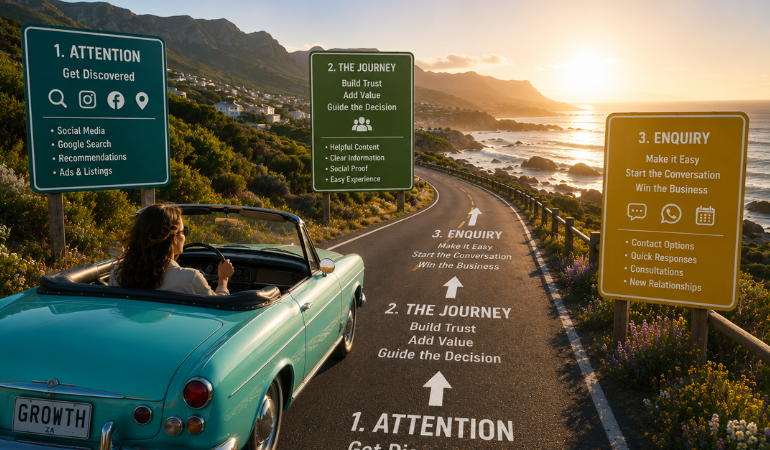
From Attention to Enquiries: How to Turn Website Visitors Into Leads
Every business wants more visibility online.
More website traffic. More social media reach. More people discovering the brand.
But visibility alone rarely pays the bills.
Many businesses celebrate growing website traffic only to discover that enquiries remain stubbornly low. Thousands of people may visit a website every month, yet only a handful take the next step.
The difference is rarely the amount of attention a business receives. More often, it is the quality of the customer journey after someone arrives.
If your goal is to turn website visitors into leads, you need more than attractive branding or regular content. You need a customer journey that builds confidence, answers questions and makes taking action feel natural.
What Does It Mean to Turn Website Visitors Into Leads?
Turning website visitors into leads means guiding people from simply browsing your website to expressing genuine interest in your business.
A lead might be someone who:
- Completes a contact form
- Books a consultation
- Requests a quotation
- Downloads a guide
- Calls your office
- Starts a WhatsApp conversation
- Signs up for your newsletter
The digital customer journey is everything that happens between discovering your business and deciding to contact you.
Every page, button, message and piece of content influences that decision.
Why Visibility Alone Doesn’t Create Leads
Many businesses assume that if more people visit their website, more enquiries will naturally follow.
Unfortunately, digital marketing rarely works that way.
Imagine driving hundreds of potential customers to a shop with confusing signs, empty shelves and no one available to help. Most people would simply leave.
Your website works exactly the same way.
Traffic creates opportunity, but the customer journey determines whether people stay, trust you and eventually enquire.
Without a clear journey, even excellent advertising campaigns can produce disappointing results.

Understanding the Modern Digital Customer Journey
Today’s customers rarely make decisions immediately.
Instead, they move through several stages before contacting a business.
Stage 1: Awareness
Someone discovers your business through Google, social media, an online advert or a recommendation.
At this stage they are asking:
- Can this business solve my problem?
- Do they look professional?
- Should I keep reading?
First impressions matter.
Fast loading pages, professional branding and clear messaging immediately build confidence.
Stage 2: Interest
Once visitors stay on your website, they begin exploring.
They may visit:
- Your services
- Your About page
- Your pricing information
- Your portfolio
- Customer testimonials
- Frequently Asked Questions
Every page should reduce uncertainty instead of creating more questions.
Stage 3: Consideration
Now your visitor is comparing options.
They may open several competitor websites before making a decision.
This is where trust becomes one of your strongest marketing tools.
Visitors want reassurance that you:
- Understand their industry
- Deliver quality work
- Communicate professionally
- Have real experience
- Produce measurable results
Case studies, testimonials and detailed service explanations become incredibly valuable during this stage.
Stage 4: Action
Finally, the visitor decides whether to contact you.
Surprisingly, this is often where businesses accidentally lose enquiries.
Common obstacles include:
- Long contact forms
- Hidden phone numbers
- Slow websites
- Confusing navigation
- No obvious call to action
- Multiple competing buttons
- No explanation of what happens next
Sometimes small improvements produce significant increases in enquiries.

Common Reasons Websites Fail to Convert Visitors
A website can look beautiful while still performing poorly.
Here are some of the most common reasons businesses struggle to generate leads.
Unclear Messaging
Visitors should understand what you do within a few seconds.
If your homepage is filled with vague marketing language instead of clear benefits, people often leave before exploring further.
Too Many Choices
When every page asks visitors to do five different things, many choose to do nothing.
Each page should have one primary action.
Weak Calls to Action
Buttons that simply say “Learn More” rarely inspire action.
Instead, explain exactly what visitors gain.
Examples include:
- Book Your Free Strategy Call
- Request a Quote
- Start Your Project
- Speak to Our Team
Specific calls to action remove uncertainty.
Lack of Trust Signals
People naturally hesitate before contacting businesses they’ve never worked with.
Trust signals help reduce that hesitation.
Useful examples include:
- Customer reviews
- Testimonials
- Case studies
- Awards
- Certifications
- Industry experience
- Recognisable clients
Trust often converts better than flashy design.
Mobile Experience
For many South African businesses, most website visitors now arrive on mobile devices.
If buttons are difficult to tap or pages load slowly, enquiries can disappear long before visitors reach your contact form.
How to Build a Better Digital Customer Journey
Creating a better customer journey doesn’t necessarily require rebuilding your website.
Often, improving a few critical touchpoints makes the biggest difference.
Start With the Customer’s Questions
Instead of asking what you want to say, ask what your customer wants to know.
Examples include:
- What does this service cost?
- How does the process work?
- Why should I trust this business?
- How long will it take?
- What results can I expect?
Answering these questions naturally builds confidence.
Make Navigation Simple
Visitors should never have to guess where to go next.
Simple navigation reduces frustration and encourages exploration.
Every important page should be reachable within a few clicks.
Guide Visitors Step by Step
A good customer journey feels almost effortless.
For example:
Discover your business.
↓
Understand your services.
↓
See examples of your work.
↓
Read customer success stories.
↓
Understand the next step.
↓
Make contact.
Each stage should naturally lead into the next.
Reduce Friction
Every unnecessary obstacle reduces conversions.
Look for opportunities to simplify:
- Shorter forms
- Faster loading pages
- Clearer buttons
- Better page layouts
- Simpler wording
- Easier contact options
Even small improvements can have a meaningful impact over time.
Show Real People Behind the Brand
Customers buy from businesses they trust.
Professional team photos, founder stories, behind-the-scenes content and authentic client experiences help create that trust.
Being human does not mean oversharing.
It simply means helping visitors feel confident that real people stand behind your business.
The Role of Content Throughout the Customer Journey
Content is not only for attracting visitors.
It also helps people make decisions.
Different content supports different stages of the journey.
Awareness
- Educational blogs
- Social media content
- Search engine optimisation
- Videos
Interest
- Service pages
- Industry guides
- Frequently Asked Questions
- Comparison articles
Consideration
- Case studies
- Testimonials
- Portfolio examples
- Client success stories
Decision
- Contact pages
- Booking pages
- Pricing information
- Consultation offers
When every piece of content serves a purpose, your website becomes a guided experience rather than a collection of disconnected pages.
Measuring Whether Your Customer Journey Is Working
Traffic alone tells only part of the story.
Instead, monitor metrics that reflect business growth.
Useful measurements include:
- Contact form submissions
- Quote requests
- Phone calls
- WhatsApp enquiries
- Strategy bookings
- Landing page conversion rates
- Time spent on important pages
- Bounce rate
- Returning visitors
These metrics provide a clearer picture of whether your website is successfully turning attention into enquiries.
Small Improvements Often Deliver the Biggest Results
Businesses sometimes assume they need a completely new website to generate more leads.
In reality, many improvements are surprisingly simple.
A clearer headline.
A stronger testimonial.
A faster page.
A better call to action.
A simplified contact form.
A more helpful FAQ.
Together, these small improvements create a smoother customer journey that encourages more visitors to take the next step.
Rather than chasing endless traffic, focus on helping the visitors you already have become customers.
Frequently Asked Questions About Turning Website Visitors Into Leads
What is a digital customer journey?
A digital customer journey is the path someone follows from first discovering your business online to becoming a customer. It includes every interaction across your website, content, search results and marketing channels.
Why do I get website traffic but very few enquiries?
This usually happens because visitors do not find enough trust, clarity or motivation to contact you. Improving your messaging, calls to action and user experience can significantly increase conversions.
Do I need a new website to improve conversions?
Not necessarily. Many businesses improve lead generation by refining their messaging, simplifying navigation, strengthening trust signals and making it easier for visitors to contact them.
What makes a good call to action?
A good call to action clearly tells visitors what they should do next and what they can expect. It should be specific, visible and easy to follow.
How can small businesses improve their customer journey?
Start by viewing your website through the eyes of a new customer. Make information easy to find, answer common questions, reduce unnecessary steps and provide several simple ways to get in touch.
Conclusion
Attracting attention is only the beginning of successful digital marketing.
The businesses that consistently generate enquiries understand that every visitor is starting a journey. Every page, every headline and every interaction either builds confidence or creates uncertainty.
Instead of focusing solely on increasing traffic, invest time in improving what happens after someone arrives. A well-designed customer journey helps visitors feel informed, reassured and ready to take the next step.
If your website attracts visitors but enquiries remain low, it may not be a traffic problem. It may simply be time to improve the journey.
At Meta Lane, we help businesses build digital experiences that do more than attract attention. From website strategy and conversion optimisation to content and lead generation, we create customer journeys designed to turn interest into action. If you’re ready to make your marketing work harder, we’d love to help.